1. Why after-sales is your profit centre
The economics of mechanical and plant engineering are asymmetric: the machine is what you sell, but service is where you earn. According to figures from Roland Berger and KVD more than 25 percent of revenue in mechanical engineering now comes from the service business; McKinsey and BCG put the EBIT margin in the aftermarket at around 25 percent - against roughly 10 percent in new machine sales. Deloitte puts service’s share of total profit at typically 30 percent - and at 50 percent or more for maintenance-intensive plants.
On top of that comes the leverage on the company as a whole: the joint study by VDMA and McKinsey („Competitiveness in a new era“, 2025) shows that companies with a service revenue share above 25 percent report an EBIT margin 3.6 percentage points higher than the rest of the industry. And the aftermarket is more crisis-resistant: if product revenue falls by 30 percent, service revenue drops by only 5 to 8 percent, according to Roland Berger/KVD.
These figures are why this guide starts with money rather than with technology. Anyone thinking about AI in after-sales is not digitising some cost centre, but the most profitable part of the company - the part where every hour of technician time won back, every second visit avoided and every enquiry answered faster feeds straight into the margin. The installed base is capital. The question is how well the knowledge about it is available.
2. The three bottlenecks holding service back
In the conversations we have with machine and plant builders, the same three bottlenecks come up in varying order. None of them is a matter of feeling - all three have been measured:
In Germany, a vacancy in mechanical and industrial engineering stays unfilled for an average of 209 days (Federal Employment Agency). According to the VDMA, more than a quarter of the sector’s workforce will reach retirement age within the next ten years - and with them goes experiential knowledge that is written down in no manual: the fault from 2011, the quirk of the machine at customer X, the trick that saves a second visit.
In an ABBYY study (Sapio Research, 5,025 respondents), 95 percent said they spend up to 8 hours a week searching for information in documents; a quarter lose a full working day a week to it. In service that means the company’s most expensive resource is paging through PDFs instead of repairing machines.
The ABB study „Value of Reliability“ (Sapio Research, 3,215 maintenance decision-makers) puts one hour of unplanned downtime in Germany at 147,000 euros - well above the global median of 116,000 euros. 67 percent of German industrial businesses experience unplanned downtime at least monthly. Every hour an answer arrives sooner has a quantifiable value.
How hard these bottlenecks bite shows up in the single most important service metric there is: the first-time fix rate (FTFR) - the share of jobs completed on the first visit. The Aquant 2025 Field Service Benchmark Report (almost 160 service organisations, over 600,000 technician jobs, 9.5 billion US dollars of service spend) shows the spread across the industry:
| Metric | Top performers | Bottom performers |
|---|---|---|
| First-time fix rate | 86 % | 53 % |
| Avoidable on-site visits | 3 % | 24 % |
| Cost gap between the two groups | up to USD 1.8 m per year | |
Source: Aquant 2025 Field Service Benchmark Report (vendor study). A failed first visit pulls an average of two additional visits behind it and extends time to resolution by 14 days.
The distance between 86 and 53 percent is rarely a tooling or a skills problem. It appears when the technician on site does not know what a colleague found out on the same type of machine three years ago, when the hotline cannot qualify the case properly up front, and when the right spare part only makes it into the boot on the second attempt. It is a problem of access to knowledge - and that is exactly why AI can address it.
3. Four areas where AI applies in after-sales and service
„AI in customer service“ is too coarse a category to support decisions. In the practice of machine and plant builders, the demonstrable benefit concentrates in four areas - and all four work on the same foundation: the technical documents, service data and field reports that already exist in the company.
3.1 Knowledge assistance for the hotline and the field
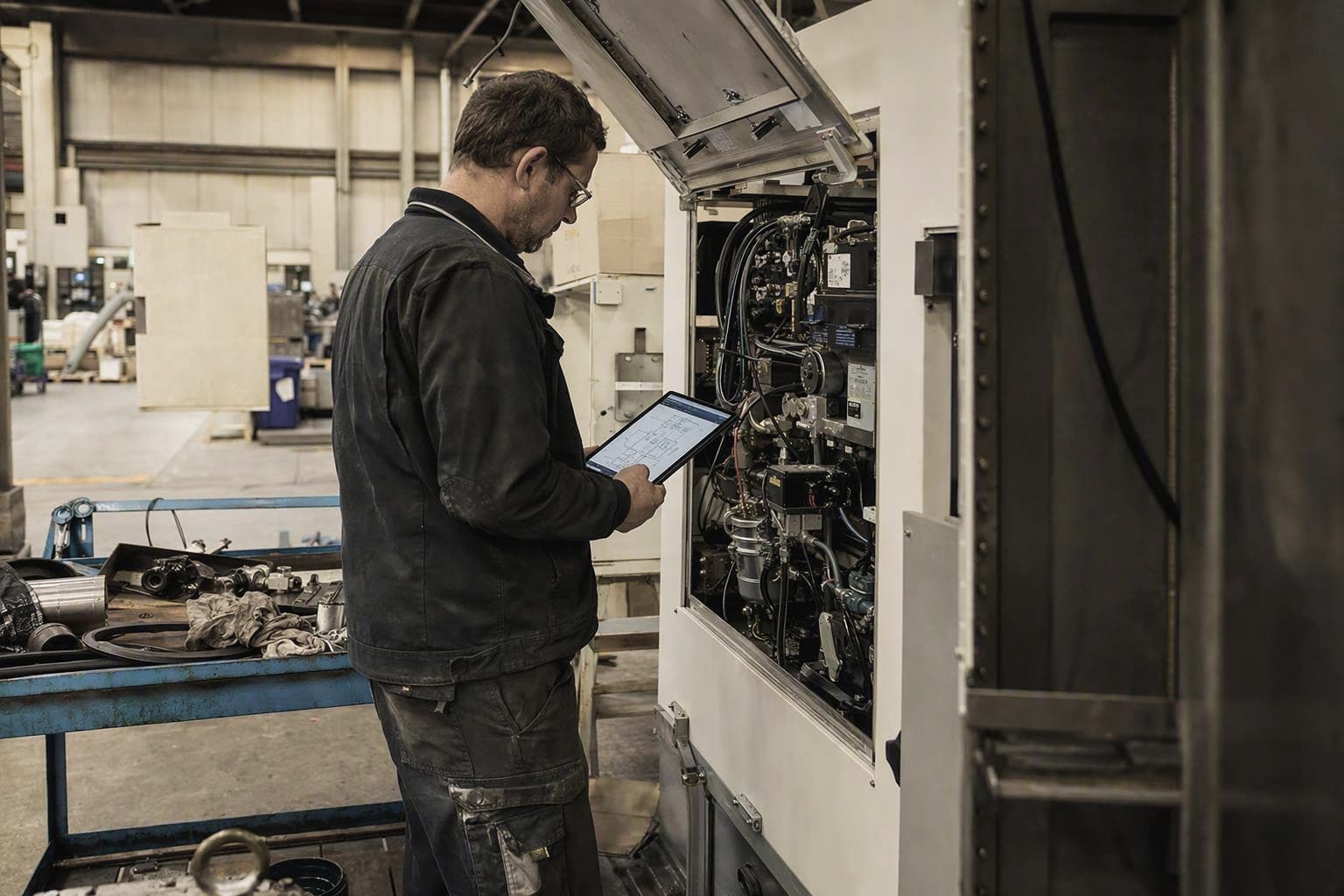
A knowledge system answers the questions that cost search time today: „Error code 4711 on series X - what was it at other customers?“, „What torque on this bolted joint?“, „Was there a modification to this plant?“. What matters is not that a system answers, but how: every answer has to show its source - document, page, section - so the technician can verify it in seconds. An assistant without source binding cannot be used in technical service, because a plausible wrong answer is more expensive than no answer at all. According to Aquant, AI-supported solutions in field service enable 39 percent faster resolution times with 21 percent higher accuracy - a vendor figure, but one you can check against your own baseline.
3.2 Identifying spare parts faster and more accurately
„Which part do I need?“ is the most expensive question in service, because a wrong answer means a second visit, longer downtime and an unhappy customer. The data for it is usually scattered across bills of materials, exploded views, legacy catalogues and the ERP. AI-supported search connects those sources: from free text („the bevel gear on the cross conveyor of the 2014 series“) or from a photo to the part number, with the context of that specific customer machine. For the spare parts business - the highest-margin block within after-sales - that matters twice over: fewer wrong orders in service, and more self-service revenue from existing customers.
3.3 Making technical documentation usable
The documentation for a plant grows over decades: variants, language versions, revisions, scanned legacy material. Almost everything exists - almost nothing is findable. Semantic search across structured and unstructured holdings changes the mode of work: the technician asks about the problem and gets the relevant section, instead of searching for the document and paging through it. The side effect is strategic: that same structured, digitally available documentation is the basis for the digital operating manual that the new Machinery Regulation permits from January 2027 (see section 6).
3.4 Resolving enquiries before a technician drives out
According to Aquant, one in seven on-site visits (14 percent) is unnecessary, and a third of service enquiries could be resolved without a technician at all. The lever is called shift-left: resolve cases as early as possible - in the customer’s self-service, on the phone, on site only if it comes to that. That only works if the hotline and the customer portal draw on the same knowledge as the best technician. Aquant calculates that just one percentage point more remote resolution saves large service organisations around 1.1 million US dollars a year. The same caveat applies: a vendor study - but the order of magnitude is consistent with what downtime costs of 147,000 euros an hour imply.
4. What realistically comes out - and what does not
The honest answer to the question of benefit starts with a calculation any service organisation can do for itself. An example, with deliberately conservative assumptions:
| Parameter | Assumption |
|---|---|
| Service technicians | 80 |
| Search time per technician per week (conservative) | 2 h |
| Working weeks per year | 46 |
| Search time per year | 7,360 h |
| At a fully loaded €65/h | ≈ €478,000 p.a. |
| Equivalent to | ≈ 4 full-time roles just for searching |
A model calculation, not a projection. The 2 hours a week are deliberately set far below the up to 8 hours in the ABBYY study. Whether a knowledge system recovers half of that or a quarter depends on the state of the data and on adoption - which is why your own baseline belongs at the start of every project.
On the metrics side, the strongest documented lever is the first-time fix rate: according to Empolis, an improvement of five percentage points can cut service costs by up to 20 percent. Together with the Aquant figures (39 percent faster resolution, 14 percent avoidable visits), a consistent picture emerges: the benefit appears where knowledge is the bottleneck.
Just as important is the other side: when AI in service delivers nothing. The VDMA survey from spring 2025 (around 200 companies) names the barriers precisely: 45 percent a lack of staff capacity, 44 percent unproven ROI, 42 percent insufficient data quality. In our view, three constellations are a clear stop signal:
- The documentation is thin or exists only on paper - and there is no budget to change that. A knowledge system can only answer what is in the data. Digitising and structuring the holdings is then the first step, not the AI.
- The cases barely repeat. If you look after a handful of special-purpose machines a year whose problems never resemble each other, the build-up will not amortise. The benefit scales with the repetition of similar cases across the installed base.
- Nobody in the company owns it. A knowledge system lives on maintenance: new service cases, corrected answers, updated documents. Without a named owner it goes stale - and a system technicians have distrusted twice will not get a third use.
5. The prerequisites: data quality, data sovereignty, operation
Data quality is the most frequently underestimated line item in the project. The typical starting point in mechanical engineering: service reports in the ERP or in Word files, documentation as a collection of PDFs spread over network drives, drawings scanned, knowledge sitting in email inboxes. None of that is a knock-out criterion - modern methods cope with mixed, imperfect holdings. But the effort for review, structuring and ongoing preparation belongs in every honest costing, as its own line item rather than as a footnote.
Data sovereignty is not a sensitivity in the German Mittelstand but the measurable main obstacle: according to the DIHK digitalisation survey 2026, 53 percent of companies distrust non-European AI providers (the highest figure EU-wide), and around half are concerned about data security. The concern is justified: service data is competitive capital. It contains which plants stand where, what fails, and how to fix it. The architectural consequence: hosting in the EU, clearly governed data use, and the certainty that your own data is not training somebody else’s model that your competitor also benefits from. How that looks in practice distinguishes providers more sharply than any feature.
Operation and measurability decide whether the pilot becomes a system. Two things belong in from the start: source binding on every answer (the technician sees where the statement came from) and defined metrics that the benefit hangs on - FTFR, search time, remote resolution rate, measured before the start and afterwards. A system whose quality nobody measures can neither improve nor build trust.
6. The regulatory frame for 2026/27
Four European legal acts set deadlines for mechanical engineering up to 2028 - and two of them argue directly for structured, digitally available service data:
- Machinery Regulation (EU) 2023/1230 - binding from 20 January 2027, with no transition period. For the first time it permits a purely digital operating manual (for instance via QR code), which must remain available for at least 10 years; in B2B, a paper version must still be supplied at the customer’s request. Anyone structuring and indexing their documentation anyway meets the requirement and creates the data foundation for a knowledge system in one move.
- EU AI Act (Regulation (EU) 2024/1689) - generally applicable since 2 August 2026. The AI literacy obligation (Art. 4) has applied since February 2025. The Digital Omnibus pushed the high-risk obligations back to 2 December 2027 (Annex III) and 2 August 2028 (Annex I) respectively. An internal knowledge system for service does not normally fall into the high-risk classes - but the question of role (provider or deployer) should still be settled early, particularly where AI moves into the machine itself.
- New Product Liability Directive (EU) 2024/2853 - to be transposed into German law by 9 December 2026. Software and AI systems will then expressly count as products; added to that are evidentiary relief for claimants and liability for failing to supply updates. For manufacturers that means documented, traceable systems are a liability matter too.
- Cyber Resilience Act (Regulation (EU) 2024/2847) - reporting obligations for actively exploited vulnerabilities from 11 September 2026 (a 24-hour deadline), full application from December 2027. Relevant to anyone shipping connected machines or software.
7. From the first use case to a running system
The sequence that has proven itself in projects is unspectacular - and that is exactly why it works:
First: measure the baseline. FTFR, search time, the share of cases resolved remotely - two to four weeks of honest measurement, on a tally sheet if necessary. Without a baseline no benefit can be demonstrated later, and the question of ROI stays a matter of belief.
Second: check the state of the data. Which sources exist (documentation, service reports, bills of materials, tickets), in what form, at what quality? The answer decides the cut of the first use case - not the other way round.
Third: start narrow. One machine type, one service team, a clearly bounded space of questions. A narrow pilot with clean measurement beats any group-wide solution on slides. What gets extended is what has proven itself.
Fourth: organise the operation. An owner, a process for new content and corrected answers, a review rhythm for the metrics. That is the difference between a tool technicians use daily and a pilot that quietly runs out.
And when providers are at the table - ourselves included - these are the three questions where substance shows:
- Does every answer the system gives show its source - document, page, section - in a way a technician can check in seconds?
- How is answer quality measured before the system is let loose on technicians - and how afterwards, on an ongoing basis?
- Where does our data run, who has access, and does anyone other than us benefit from what the system learns from our service cases?
8. Sources
Every figure cited in the text, with its origin. Studies by vendors with a commercial interest of their own are marked as such. Most sources are in German.
- Roland Berger / KVD as well as McKinsey/BCG on after-sales economics (service revenue share, EBIT margins, crisis resistance): summarised at logicline.
- Deloitte, Service performance in mechanical engineering (service’s share of profit).
- VDMA/McKinsey, „Competitiveness in a new era“ (2025): the EBIT effect of service revenue shares above 25 percent.
- Aquant, 2025 Field Service Benchmark Report (vendor study): FTFR, avoidable visits, remote resolution rate, AI effects.
- ABB, „Value of Reliability“ (commissioned study, Sapio Research): downtime costs.
- ABBYY, study on document search (commissioned study, Sapio Research): search times.
- Empolis, on the first-time fix rate (vendor figure): the cost lever of an FTFR improvement.
- VDMA, AI survey spring 2025: adoption and barriers.
- DIHK, digitalisation survey 2026: distrust of non-European providers, data security.
- Federal Employment Agency, skilled labour shortage analysis: time to fill vacancies in shortage occupations.
- Legal texts: Regulation (EU) 2023/1230 (Machinery Regulation), Regulation (EU) 2024/1689 (AI Act), Directive (EU) 2024/2853 (Product Liability), Regulation (EU) 2024/2847 (Cyber Resilience Act); deadlines per the Digital Omnibus: TÜV Rheinland Consulting.
After-sales is the part of mechanical engineering where knowledge turns into money most directly - and where lost knowledge costs money most directly. AI changes nothing fundamental about that. What it changes is how much of the knowledge you already have is available at the decisive moment: on the phone, at the machine, in the spare parts store. Anyone who knows their own baseline, assesses the state of their data honestly and starts small can demonstrate the benefit instead of having to believe in it. That is exactly the order in which we would approach it.